Wild bees

A while ago, a graduate student from the University of Connecticut asked us if he could include LaGuardia Corner Gardens as a site for his study of solitary bees in urban and non-urban areas. After confirming that this research would neither harm bee populations nor gardeners, we were happy to support it.

A couple of weeks ago, Matthew and his undergraduate assistants Maddy and Emily came to the garden to check out the situation. They monitor sites all over the city and were very happy to report that our garden has a lot more bees than Central Park!

Here, we are not talking about honey bees or bumble bees that live in hives or colonies with a queen and many workers. This research is about wild bees where each female makes her own nest. These nests can be in the ground, inside of hollow plant stems, in holes in wood or even in cracks in walls. The size of solitary bees ranges from very tiny to relatively huge. None of them sting unprovoked. They don’t have a hive to protect and can afford to be less aggressive than honey bees (at this time of the year, honey bees also only sting when they feel threatened).

On this day, the researchers were particularly interested in the large carpenter bees that visited our flowers in sizable numbers. Matthew, Maddy and Emily captured bees with their nets, gently put them into a little container, painted a green or pink dot on their backs (green for males, pink for females), and let them fly off again. The colored dots were meant to avoid collecting the same bee more than once. From females, Matthew took a small sample for genetic testing. This way, he and his team can learn about the genetic diversity of the different populations they study. The bees were mostly unfazed but clearly weary of the net when it got near them for a second time.

How does one distinguish male from female carpenter bees? This is really easy: females have a black face like the one in the photo above. Males have a white face. The left bee in the net is a male.

There were also other solitary bees out and about: we saw some tiny masked bees and the first males of our resident leaf cutter bees. Female leaf cutters will emerge a little later. Below is a male on a milkweed flower. The photo was taken last year in June, milkweed is not blooming yet.

Unfortunately for the solitary bees, last week was rainy, windy and unseasonably cold. Not the best conditions for finding a mate, collecting pollen and building a nest.

Solitary bees can’t fly long distances like honey bees and they don’t have any honey provisions either. This is one reason to plant as many flowers for them as possible. Those are flowers that produce abundant nectar and pollen. This means plants with single flowers instead of flowers with lots of petals but no stamens, e.g. lacecap instead of mophead hydrangeas and single instead of pompom chrysanthemums. Of course, we still love our blue hydrangeas, roses and peonies, but we add some native asters, goldenrod and bee balm to the mix.

Happy Mother’s Day!

What a glorious day it is today! The sun is shining, the sky is blue, it is gently warm and the roses are blooming.

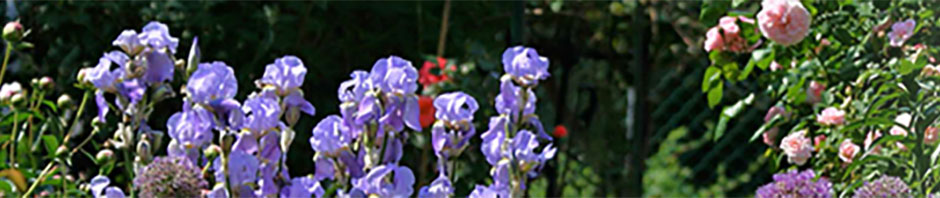
The lovely weather arrived yesterday after a week of rain. This rain was actually greatly appreciated since we still have issues with our water system. And see just how lovely the irises look with rain drops on their petals!

Yesterday was sunny and breezy. We had organized a little crafts workshop in the garden to make mother’s day cards with pressed flower petals.

The wind made this project a little challenging. Dried flower petals are very light and fly off so easily. But our visitors managed well. Several kids came with their moms and dads, and even the littlest ones made lovely cards with a bit of help. I hope they all had fun, I did!

This card with petals of our variegated tree peony was made by a young mom to be: she expects her first baby in a few months. We wish her the best of luck!

A new composter

Many years ago, we got our first compost tumbler. It served us well for a long time, turning plant clippings and weeds into valuable fertilizer for our garden. Unfortunately, over time, the good old thing became harder and harder to turn. None of us is getting any younger or stronger, thus, this year, it was time for a replacement. We had good experience with the Mantis brand of tumblers that have a crank for easy turning and a larger capacity.

This Sunday it was time to put the new Mantis together. Sophia and Gio did the honors.

After moving the tumbler to its new spot, it got its inaugural fill and is now ready for business. Thank you Sophia and Gio!

Otherwise: Spring is progressing very fast, almost too fast to enjoy it properly: Just a few days ago, the apple blossoms were so dense that one could hardly see any leaf or stem. Tulips were blooming in many colors. Now, both are already fading.

Instead, the tree peonies and the early irises are in full bloom. Soon, it will be time for roses.

Easter Weekend with Pottery

The last weekend was quite busy for the garden. For one thing, the weather was warm and sunny. Tulips were bursting with colors and the crab apple tree was in full bloom.

We were also treated to a very special “event”. Our beloved former chair Barbara Cahn, who passed away suddenly two years ago was a professional potter with a very unique style. Many gardeners and friends bemoaned that they had missed the opportunity to acquire one of Barbara’s beautiful pieces while she was alive.

This weekend, everyone had their chance. Barbara’s husband and two of her nieces and family generously gave away pottery from Barbara’s inventory to everyone who wanted a piece. They reasoned that every bowl, cup, plate and tray would be better off in someones home where it could be loved and admired than boxed up in storage.

Thank you very much, we were so grateful for this opportunity!

The garden at night

Last night, I went to the garden after dark. Bags with weeds and plant clippings had to be brought to the curb for compost collection the next morning. I walked around to find out what I could see at this time of the night.
It never gets dark in New York City. There are enough street lamps, illuminated store fronts, office windows lit day and night and car headlights to illuminate every corner of the city and drown out all but the brightest stars. This is a problem for moths and other nocturnal insects and for migrating songbirds who get confused by all the light sources they mistake for the moon. And still: the garden looks magically transformed at night. Tulips and daffodils glow like lanterns and the stalks of last year’s sunflowers look like foreign objects.
I was reminded of the photographer George Hirose, who specializes in night photography and came to LaGuardia Corner Garden many years ago to take photos for a series called “Midnight in the People’s Garden”. I wonder what is going on with him and if he is still walking around the city with his camera at night.