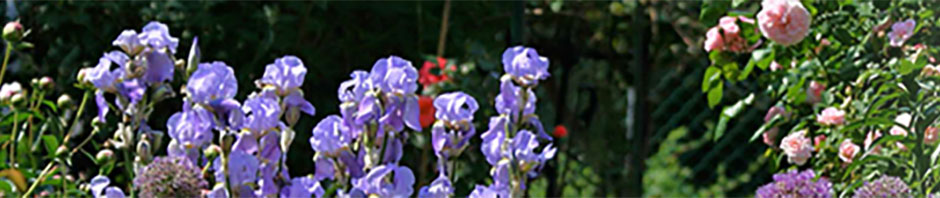
This is the guide for our fourth annual Rose Walk:
Enter the gate and look to your left. There is a collection of roses that include Alba White Meidiland, Stanwell Perpetual—an ancient cross between a Burnet rose (Rosa spinosissima) and a Damask rose—and Charles Mallerin.

Madame Hardy
Now, continue on the path and under the arbor covered with Don Juan. Through the arbor to your right is Ploxy Baby, a 2016 winner of the American Garden Rose Selections. Directly in front of you in the border, The Fairy is planted to the right of the large Rosa laxa. Please take a look at the other roses in this area to your left, which have yet to be identified.
Heading up the path, you will see Madame Hardy in the border, a Damask rose that is considered one of the most beautiful white roses ever bred (in 1832 by Alexander Hardy who named it after his wife Félicité). Next are several specimen of the Floribunda rose Pink Simplicity. To your left is the lavender colored Paradise.

Lavender Dream
Further down the path reveals Lavender Dream. Proudland is the red rose to your left. This area also contains several unidentified roses.
Turning the corner, Dream Weaver appears and there is also Pretty Jessica.
The next corner contains Chrysler Imperial, one of our oldest roses that was planted in a brick well 35 years ago. It won a Green Thumb contest and a wheelbarrow for the garden back in the ‘80’s.

Dr. Huey
Turning the tight corner, you will come to a large grove of tall red roses, Dr. Huey, frequently used as rootstock for hybrid roses. You will also see Senior Prom and Citrus Tease, and to your right is a rose which we still need to identify.
Following in the border is White Dawn. Look back into the garden to see Orange Honey Sunny Yellow Knockout and Oso Happy Smoothie Pink. There is also Baronne Prévost, an antique Damask perpetual, and Green Ice, grown from a cutting a couple of years ago.

Livin’ Easy
Next is Livin’ Easy, and in the border, you will find French Lace, Eglantyne and Morden Blush. In the middle of the garden is one recently planted old garden rose Apple blossom, which was newly grown by the Heritage Rose Foundation and donated to a Green Thumb rose pruning event in Harlem three springs ago.
By now we are sure you are drawn to Zephirine Drouhin. This thornless beauty has been with us a long time. HapLivin’ Easypy Chappy and Peach Drift, which came to the garden from an AARS giveaway in Union Square years ago, are also here.

Souvenir de la Malmaison
Please continue down the path, past the gate, and on your way to the patio. You will pass Love and Peace, which was planted in honor of two young neighborhood NYPD auxiliary officers, Nick Pekearo & Eugene Marshalik, who were gunned down on Sullivan street in 2007. Next is Chicago Peace. Follow your nose and be enthralled by the fragrance of Souvenir de la Malmaison, one of our Bourbon roses.

Ballerina
This next section, next to the patio, is the most concentrated rose garden. Within this area, you will find two other Bourbon roses, Kronprinzessin Viktoria and Captaine Dyel de Graville. There are also a rare Canary Island Damask rose next to Munstead Wood and the hybrid Tea rose Leonie’s Appoline. Near the back fence is Pat Austin.
On the other side of the patio, there is small hybrid tea rose called Heirloom. You will also find the Rosa rugosa cultivar Henry Hudson and the hybrid Musk rose The Ballerina. The Ballerina appears again with Dames de Chenonceau and a Pink Meidiland. The very last plot has The Fairy, Tropicana and Dan Poncet.
After leaving the garden, please also take a look at our small North Garden which contains a pink double Rosa rugosa variety and Pink Simplicity. You will also find The Prince behind a red rose, which we still need to identify. Finally, there are the European wild rose Rosa rubifolia and Maigold.
Thank you for coming! We hope this has been enjoyable and informative. We appreciate your ideas and input. If you think you can identify any of our mystery roses, please inform the guardian on duty or send us an e-mail: lgcgardens@gmail.com.

Pat Austin (Photo: Hubert Steed)


