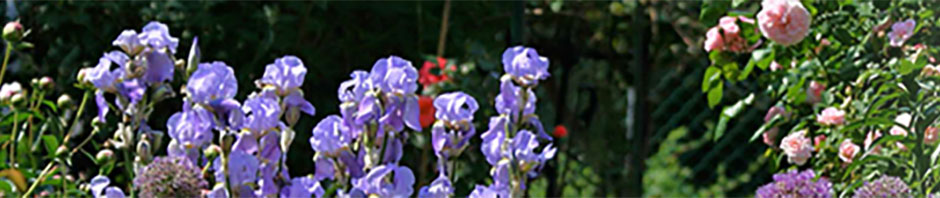
The garden in early May

Spring is such a busy time for gardeners, and not much is spent at a computer. Therefore, I have some catching up to do.
A lot has happened over the last weeks. We finally finished pruning all the roses in mid April. Last weekend, All roses were also fed with special organic rose fertilizer. To fortify the rest of the garden, we got a delivery of compost from the City of New York. This is wonderful, since we cannot possibly make enough compost for the entire garden ourselves, even though we will have two composters soon. We got a grant to purchase a second one!

Meanwhile, the crab apple tree and the red and pink tree peonies bloomed spectacularly. As usual, it rained on them, so by now the show is likely over (but visit soon and you’ll see the yellow tree peony in bloom. It is a little later).

The crab apple was most beautiful on Easter weekend. The tree peonies looked their best a week later.

We actually got quite a bit of rain and the temperature jumped between chilly and almost too hot. But what else can we expect from April?

On Easter Sunday, it was hot enough to need a bath!

In mid April, we resumed our usual open hours, that is, the gate is unlocked in the morning and closed at night on all nice days. On weekend afternoons, a garden member is in attendance to answer questions and chat with our visitors.

There is no spring without tulips. Here are some of our beauties. The one on the top right is the kind for which people sold entire estates during the tulip craze in the 17th century. Today, these tulips are affordable. In case you wonder: The white stripes are caused by a virus.

Earlier this year, I had reported that our bees had survived the winter. But we were fooled! The bees that we saw flying in and out of the hive were robbers from a different colony who came to steal the honey from our hives. This was a disappointment. We were hardly the only beekeepers who lost their colonies this winter. Supposedly, wildly fluctuating temperatures together with the almost unavoidable mite infestation was particularly hard on honey bees this winter.
However, last weekend, we got two new queens, each with a small royal court of a few hundred workers. They were placed into our two hives. This weekend, our beekeepers checked whether they had settled in all right. Things look good in the white hive.

Both hives have new tenants. The white plastic box that Sara removes from the hive in the middle photo contained the queen and her workers. This is how bees are shipped across the country (by mail!) and this is how Sara and Barbara transported them on the subway to our garden. Over the last week, the queen had moved from the plastic box into the hive.

We are also seeing other insects in the garden: large bumble bee queens looking for a nest site, and the first butterflies. It is amazing how fast everything is changing now. Pretty soon, all the roses will be blooming. Our Rose walk will begin on May 18!

A painted lady. This butterfly overwinters far south as adults. This is why it looks a little beaten up and not as brilliantly colored as when it first came out of its pupa.

Earth Day Art

It is now a tradition: the first-graders at the Little Red Schoolhouse create artwork for Earth Day which is then displayed on our fence.

This year, the theme was truly earthy: the students used clay to make prints. This resulted in their most abstract art show yet. It is very fun!

Some examples of this year’s Earth Day Art.

Who can should visit the exhibit. The artwork will be showing for another two weeks. And then, it will be time for the Rose Walk!

Pruning roses

As you may know, we are proud of our roses. We are blessed with over 50 varieties that gardeners have accumulated over the years. Every year, they put on a wonderful show of abundant flowers. To be at their best for our Rose Walk in May (this year scheduled for the weekend of May 18/19), we need to take care of them now.

Most roses need a pruning in early spring, before they start growing. This year, we offered a rose pruning workshop through the community garden umbrella organization GreenThumb. Because we have so many different types of roses and one of our gardeners is a rose expert, we wanted to share our expertise.

Workshop participants check out different pruners. For pruning roses and any other woody plants we really only want to use bypass pruners. Stems thicker than a thumb are better cut with long-handled loppers.

On a beautiful sunny day in March, a group of gardeners from as far away as Forest Hills in Queens gathered to watch Shinichi take the bypass pruners to our roses. First, we tackled some of the hybrid tea roses. For them to grow nice, large blooms, they can be cut back by 2/3 of the length of the stems. To encourage a nice shape of the new growth, we prune the stem to an outward facing bud. This will prevent later criss-crossing of the stems.

Roses are cut above an outfacing bud. These here are seen a couple of (cold) weeks later when the bud below the cut started to swell.

Next, we tackled “Livin’ Easy”, a large Floribunda rose that had grown very tall last year. Here, we wanted to simplify the structure of the plant by cutting out crossing stems from the middle and shortening the canes by about half. Like hybrid tea roses, Floribunda roses can deal with pruning beyond the usual 1/3 rule, especially if the rose is as vigorous as our Livin’ Easy. (This rule says that pruning by more than 1/3 at a time is weakening the plant. It applies to all shrubs and trees.)

Livin’ easy before pruning. It had grown really tall over the last year (Photo: Elisa Monte). The inset shows one stem as it looked a month later. This is really a vigorous rose!

Everybody offered suggestions, where to cut Livin’ Easy back. When we were happy with our work, we gathered for a group photo. Check out below how this rose looked after pruning.

Some participants of our workshop with Livin’ Easy in the foreground (Foto: Elisa Monte).

Finally, there are species roses and the old garden roses: Damasks, Bourbons and Hybrid Musk roses. These are not pruned at this time of the year. They flower only on the canes from the previous year, if we cut now, we’ll remove all flower buds! Of course, the three D apply to all shrubs, so we did cut back all damaged, diseased and dead canes. We also removed criss-crossing branches and shortened the tips of the canes just a little to maintain the shape of the rose.

Discussing how to prune Madame Hardy, a Damask rose. Here, only  the tips of the branches were cut. A few weeks later, the buds are growing nicely.

With so many roses, we are still not quite done with pruning all of them. Fortunately for us, it has been pretty cold since the beginning of March, and it is not too late to finish the job this weekend. I better get my shears ready!

Spring is here!

Snowdrops, Helleborus and winter aconites are in bloom right now.

Today, it was warm enough for taking off that winter jacket. It was also warm enough for our bees to come out of their hive in numbers. We were so very happy to see them. Not every year do the bees survive the winter, but this year, they did!

Bees at the entrance to the hive. Some were feeding their sisters, probably with fresh nectar from some of the flowers nearby.

Some winter aconite flowers had opened a few days earlier right in front of the hive. At first they had no visitors.

Visitors of the winter aconites. The one on the bottom left corner pretends to be a bee. It is, however a hover fly. The others are indeed bees from our hive.

Now, however, bees (and a fly) were busy drinking nectar and collecting a little pollen from these lovely yellow flowers.

Most bees seemed to come home to the hive from further away. None of them brought back a lot of pollen. There is just not much blooming right now, although in the plantings nearby, daffodils had opened their flowers almost over night. Unfortunately, these daffodils, bred by us humans for large colorful flowers, are not very attractive to any pollinator. Bees seem to mostly ignore them. Hopefully, other flowers will open soon and provide the pollen that our bees need to raise their larval sisters.

Daffodils are not very attractive to pollinators. But crocus are.


Catching up: Youth Leadership Council

It suddenly got cold in New York City. It’s a good time to remember what was going on in the garden this summer. One story we love to share is here (by Barbara Cahn):

This summer, our garden participated in the Youth Leadership Council, a program run by the city to engage high school and college students in volunteer work. Between April and the end of July, we hosted a group of students from around the city, most of whom had never gardened before.

Barbara and some of our students are inspecting their plants.

Our member Dr. Eileen Ain generously lent her plot to the group for the summer so that the students could get their hands dirty and grow their own vegetables and herbs.

Sara Jones taught them how to prepare the soil and plant lettuce and beans from seeds, and tomatoes, peppers, cucumbers, chard and basil from seedlings. Our students even grew potatoes in a laundry basket!

The little plants got their markers, and the map shows where everything is. The “Enemy Territory” contains mostly harmless peonies.

The YLC members mapped the plot, made labels for the vegetables, and cast mosaic stepping stones to make a path. They learned to maintain the plot by weeding and watering, composted the weeds, sieved the finished compost and put it back to fertilize their plants. They also came to know the garden’s honeybees and butterflies.


New stepping stones line the path between tomatoes and Iris and basil plants. The potatoes are in the baskets seen in the back.

Several garden members taught mini-workshops in making sun prints (Erica Uhlenbeck),  hydroponics (Karin Kiontke), vertical gardening (Sarah Blakeley), drip irrigation (Jen Sloan), meditation (Eileen Ain) and seed saving (Barbara Cahn.)

The YLC students learn about hydroponics (growing plants without soil; most of your “baby kale”, “baby spinach” and “baby lettuce” is grown this way) and collect seeds from Barbara’s kale plants.

At the end of the program, the students harvested the produce they had grown, and turned it into salads, cooked dishes and desserts, and we invited gardeners and neighborhood residents to a party to celebrate the season.

Yummy cherry tomatoes and healthy kale are ready to harvest.

Party with food made from the harvested veggies: cucumber salad, pasta with pesto from our own basil, a salad bowl with lettuce and tomatoes from the student’s plot, of course the little potatoes, and to drink mint-strawberry lemonade. The lady in black is Eileen, who allowed the students to grow all of these goodies on her plot.

In August, we attended a graduation ceremony at the United Nations, which had the theme “Migration and Agriculture.” The students made a pretty poster and gave a presentation on how this theme relates to our work.

Graduates and teachers of the Youth Leadership Council at the UN on August 23.

For us, this was a valuable experience. Eileen puts it this way: “We have all learned so much and are thankful that we have become trail blazers to solving a global need for fresh, healthy food. Seeing the graduates at the UN gave me hope. Yes, I would give my plot again.  It was a vibrant summer with gardeners giving wonderful young New Yorkers tools for life. We are all in gratitude for these experiences in our community garden.”

We were very happy to welcome these students into our garden and hope they will be able to use their gardening experience in the future.